The AI Google Ads agent behind ahmeego.com is now a native app — one Expo codebase, the same Cloudflare Workers backend, and every audit, ad-copy, and creative-validation workflow rebuilt for one thumb. Here's what ships in v1 and where to get it.
For two years, Buddy has lived in a browser tab. That was fine when the work happened at a desk — but Google Ads doesn't wait for desks. The delivery shift you need to catch happens while you're on a train. The creative that needs a spec check before the platform rejects it is sitting on your camera roll. The "what's our CPA doing?" question from leadership lands while you're in line for coffee.
So we packaged the whole agent for the two places your thumb already lives: Buddy is live on both Google Play and the App Store today. This post covers what ships in v1, how it's architected, and how to use everything right now.
TL;DR: Buddy is live on Google Play and the App Store now. Same account, same credits, same 28-action backend as the web agent. The full agent also runs in your phone's browser at ahmeego.com/tools/auditor/app — and the apps page has everything in one place.
This isn't a companion app or a notification shell. It's the full agent — the same one that runs on ahmeego.com — with a native surface for each core workflow:
The 250-point audit, from your pocket
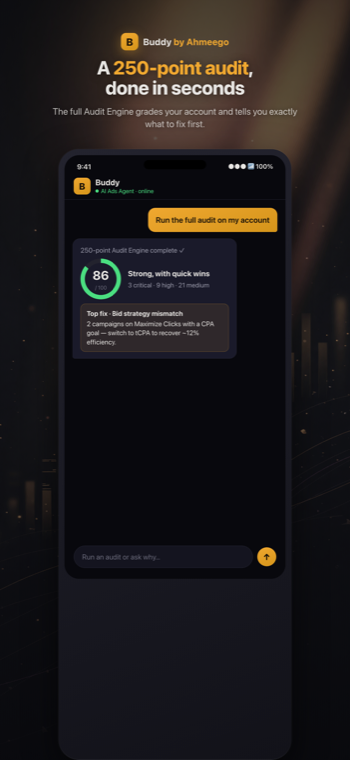
Ask Buddy to run the full Audit Engine and it grades your account, ranks what to fix first, and explains the "why" behind each finding — bid strategy mismatches, conversion tracking gaps, budget pacing issues, the works.
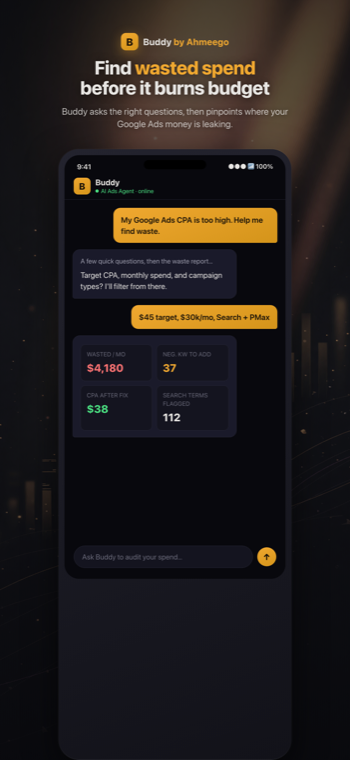
The Audit Engine grades the account and hands you the fix list, prioritized.Wasted-spend hunting: $4,180/mo of leakage, 37 negatives to add, CPA after fix.
Ad copy, keywords, and the quarterly plan
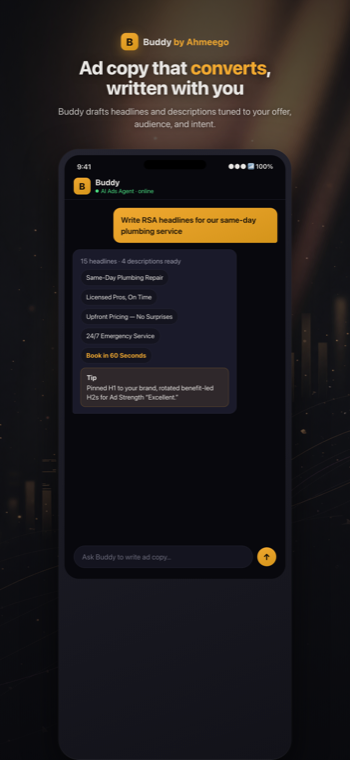
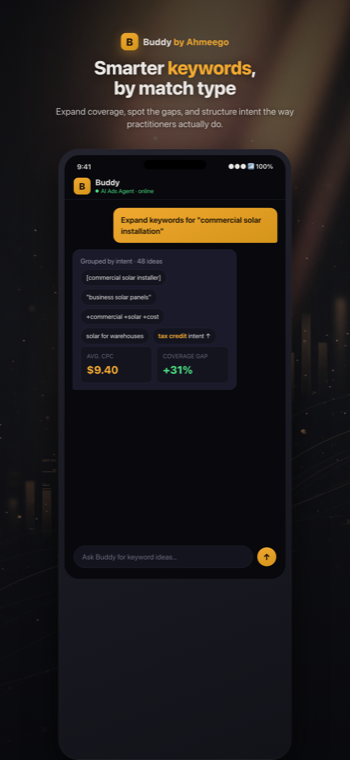
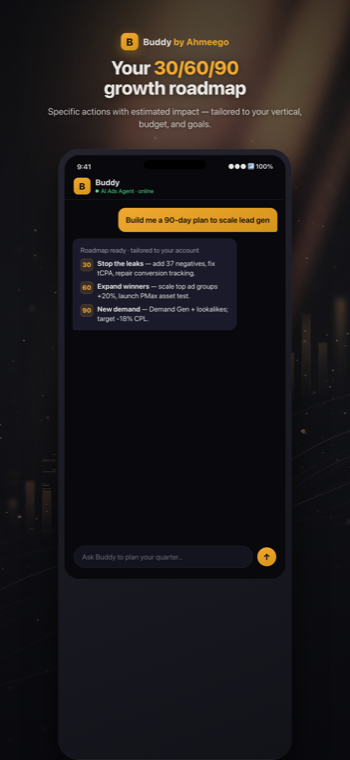
The writing and planning workflows made the jump too: RSA headlines and descriptions tuned to your offer, keyword expansion grouped by match type with CPC and coverage-gap estimates, and 30/60/90 roadmaps with estimated impact per phase.
15 headlines · 4 descriptions, with pinning strategy for Ad Strength.Keyword expansion the way practitioners think: by match type and intent.30/60/90 roadmaps: stop the leaks, scale the winners, open new demand.
The camera is the new upload button
The Creative Validator is the most mobile-native feature in the app: point your camera at an asset (or pull from your library), and Buddy validates it against 50+ ad platform specs — dimensions, formats, safe zones — then resizes it before you submit. Creative rejections are the silent launch-date killer; catching them from a phone, at the moment the asset exists, is the point.
Analytics tag scanning
Paste any URL and Buddy scans 10 tag platforms for tracking gaps — GA4, Google Tag Manager, Meta Pixel, Google Ads conversion tags — and hands you the exact fix for whatever's missing. If you've read article #6 on conversion tracking as your moat, this is that thesis with a camera and a keyboard.
How it's built (one codebase, zero backend changes)
The app is Expo/React Native — one codebase compiling to iOS, Android, and web. The architectural decision that made this shippable in weeks rather than quarters: the mobile app is just a new client for the backend that already existed.
Mobile app (Expo/RN) → Cloudflare Workers API gateway → The Loop orchestrator → 28 actions + 6 sub-agents. Zero backend changes.
Everything we've published about the agent stack — the open-source tooling, the Workers/D1/Vectorize infrastructure, the orchestrator loop — is exactly what the app talks to. That's also why your account carries over with nothing to migrate: sign in with Google or Apple and your credits, chat history, and connected Google Ads accounts are just there, synced in real time between web and mobile.
A few native-only additions that shipped in the store builds:
Sign in with Apple — verified against Apple's JWKS on our Workers backend, minting the same session as Google sign-in.
Push notifications — a credits-low ping when a deduction crosses below 10 credits, so the agent can get your attention even when the app is closed.
Real PDF & CSV export — any chat, audit, or report goes out through the system share sheet as an actual PDF, not a screenshot.
In-app purchases — credit packs through the store billing systems, with balances that update live in every open surface.
Where the stores stand (honestly)
Android: live now.Buddy by Ahmeego is on Google Play today, with the latest build (push notifications, credits sync, PDF export) rolling through Play's production track.
iOS: approved and live. The App Store build cleared Apple's review — Sign in with Apple, production push notifications, and PDF export all made it through. Download Buddy by Ahmeego on the App Store.
You don't have to wait: Buddy runs fully in your phone's browser today at ahmeego.com/tools/auditor/app — same agent, same audits, same tools. The app will feel like home on day one because it literally is the same backend.
There's a deeper thesis here, and it's the same one that runs through everything at It All Started With A Idea: the gap between "I noticed a problem" and "I acted on it" is where paid-media performance dies. Every hour between a delivery shift and its diagnosis is budget spent on the wrong thing.
A specialist-grade agent in your pocket collapses that gap. Notice → ask → understand → act, in one surface, in the minutes you actually have. That's not a smaller version of the desktop workflow — for most day-to-day PPC judgment calls, it's a better one.
Get Buddy
Android users can install right now. Everything else lives on the new apps page: the preview video, the full v1 feature rundown, live store status, and the browser-based agent. The iOS App Store link lands there first.
v1.1 is already scoped: deeper dashboard views, more of the 9 web tools going native, and widget/watch surfaces we're deliberately not promising dates for. The build-in-public thread continues on Substack and GitHub — and if the store-review saga produces a story worth telling (they usually do), it'll show up here.
— John
Sources & references: Direct observation from building and submitting the Buddy mobile apps (Expo/React Native, EAS builds) between June and July 2026. Store status as of July 10, 2026: live on both Google Play and the App Store. All screenshots are captures from the actual store builds; the preview video is the store listing asset. AHMEEGO is not affiliated with, endorsed by, or sponsored by Google LLC or Apple Inc.