How an AI Agent Migrated Two WordPress Sites Into One Headless Storefront — Without Losing a Lead, an Order, or a Ranking
A real-world case study: Claude Fable 5 inside Cursor, with Buddy as the live browser bridge, executed a full business migration — two WordPress sites to one headless Astro storefront, WooCommerce to Shopify, every CRM automation verified against live execution logs before anyone declared victory.
Squeaky Clean Turf is a family-run artificial-turf cleaning company in Phoenix, Arizona, owned and operated by David Schrimpf and Dalis Smith. When this project started they had two WordPress sites (one for services, one for their WooCommerce product line), a GoDaddy hosting bill, a Google Merchant Center account throwing misrepresentation warnings, and a GoHighLevel CRM that only half-knew what the websites were doing.
Over the course of the project, an AI agent — Claude Fable 5 running inside Cursor, with Buddy as the live browser bridge into the tools that have no usable APIs — executed the entire migration:
Two WordPress/WooCommerce sites → one headless Astro site on Cloudflare Pages
Every form, chat, order, and review → GoHighLevel, across two sub-accounts, with every published workflow tested against live execution logs
Google Merchant Center fixed — domain verification, product identifiers, measurements, and a custom product feed
SEO preserved and upgraded — 301 maps, consolidated domain authority, a full schema/E-E-A-T pass, GTM rebuilt for the new stack
The result is a faster, cheaper, safer stack — and a checkout, lead, and automation pipeline that was verified working before anyone declared victory, not after. This post documents what was done, what broke, and what an AI agent with a browser bridge changes about the economics of the whole exercise.
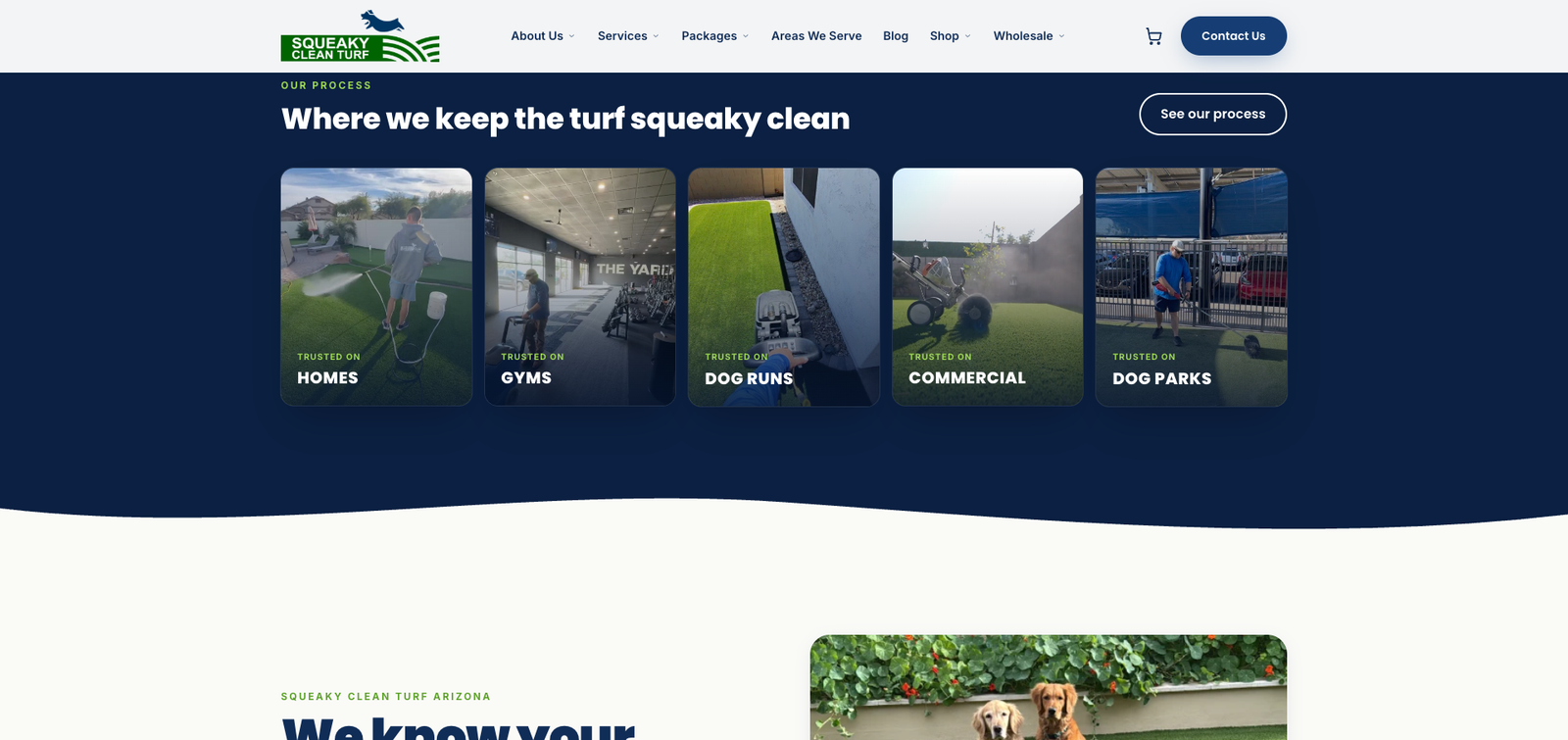
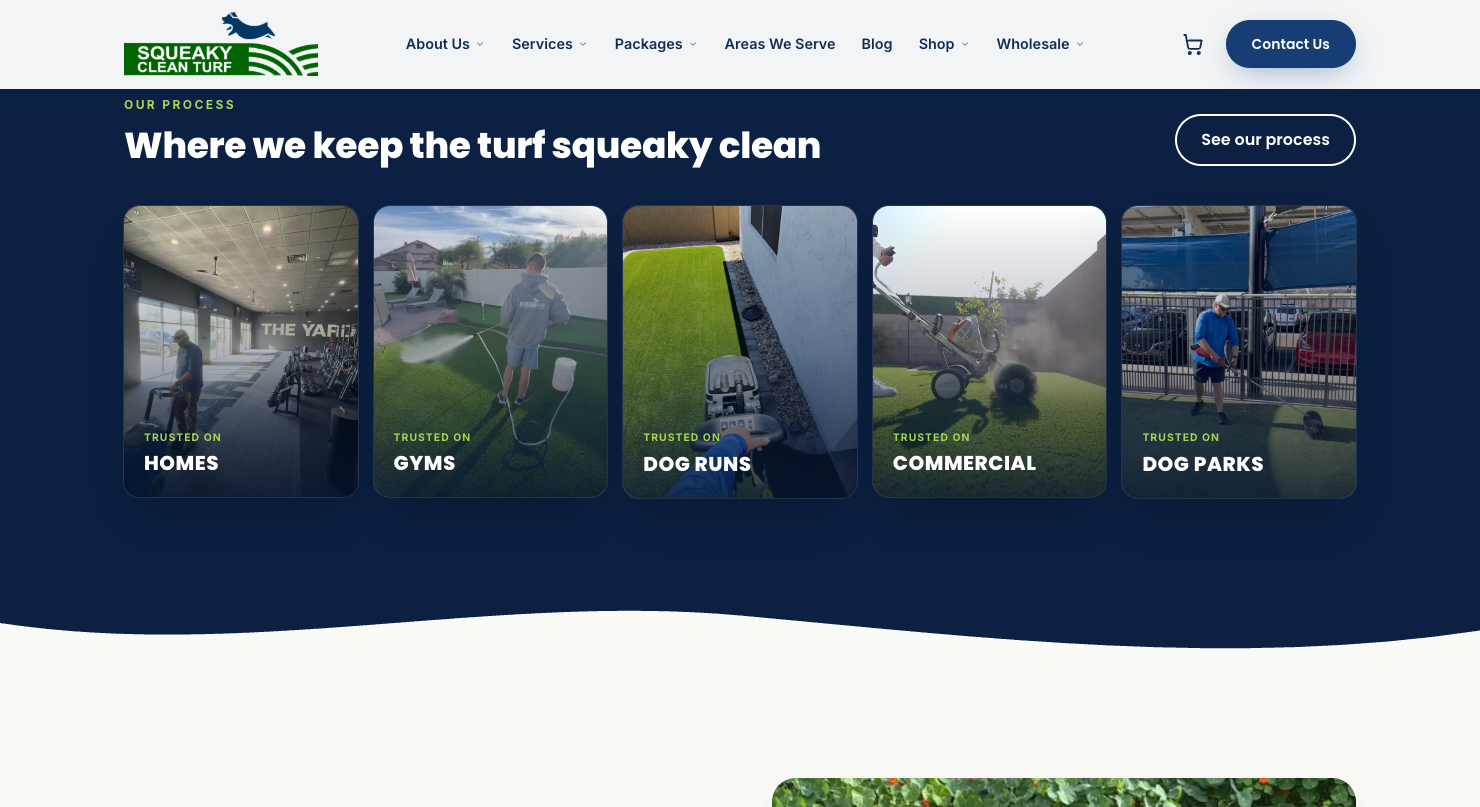
The live site after migration — static Astro on Cloudflare Pages, every tile showing the right image (more on that below).
The starting point
The business: a local service company (turf deep-cleaning packages) plus a product company (their own turf cleaner, sold retail and wholesale, including a subscription).
Layer
Before
Service site
WordPress on GoDaddy (squeakycleanturf.com)
Product site
Separate WordPress + WooCommerce (squeakycleanturfcleaner.com)
Checkout
WooCommerce + aging payment plugins
CRM / automations
GoHighLevel, two sub-accounts, wired to WP forms
Shopping ads
Google Merchant Center, flagged with errors
Analytics
GTM configured for the old WP templates
The problems, in order of how much they were costing the owners: two domains splitting brand authority and backlinks; WooCommerce maintenance burden (plugins, PHP updates, security patches); Merchant Center misrepresentation warnings; CRM automations that fired for some channels and silently missed others; and a mobile experience that did not match desktop.
The target architecture
Why headless, in one paragraph: the site itself is static HTML served from Cloudflare's edge — there is no origin server to hack, no plugin stack to patch, and nothing to slow down. Anything dynamic (quote forms, newsletter, the Merchant Center feed) runs as small serverless functions. Shopify handles the one thing you genuinely should not build yourself — PCI-compliant checkout — through its Storefront API. The CMS-shaped problems (content, blog, packages) live in version-controlled code, which means every content change is reviewable, diffable, and reversible.
Astro (static) on Cloudflare Pages
├── Shopify Storefront API → cart + checkout
├── Pages Functions (/api/*) → forms, newsletter, feed
├── GoHighLevel (2 sub-accounts) → CRM + automations
├── Google Tag Manager → GA4 + conversions
└── Merchant Center → custom XML product feed
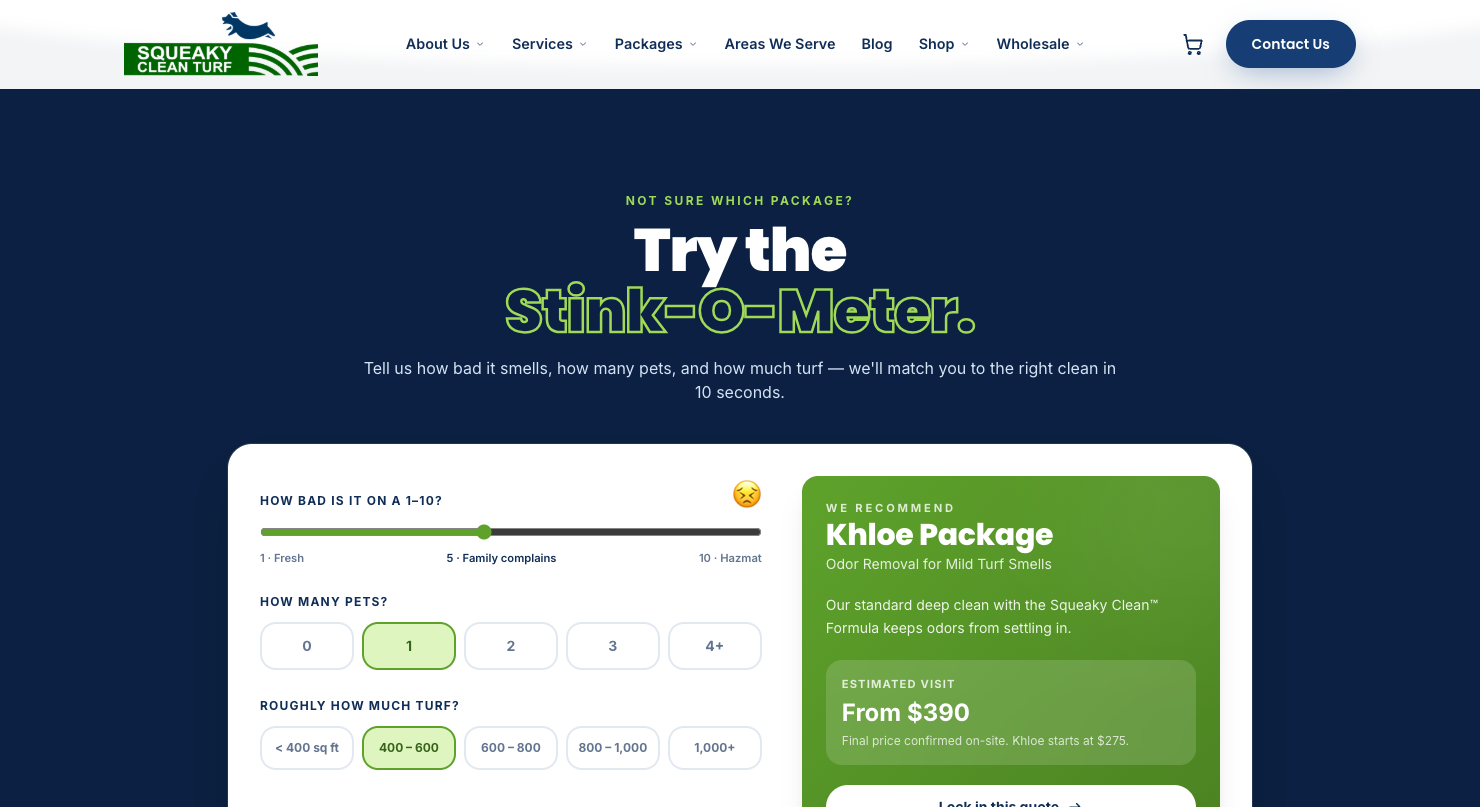
One of the rebuilt pieces the owners love most: the Stink-O-Meter, an interactive estimator that scores smell, pets, and square footage, recommends a package with live pricing, and deep-links into a pre-filled quote form. Package pricing was rebuilt as data, not prose — one source of truth that the estimator, booking widgets, and FAQ all read from.
The Stink-O-Meter — a React island in a static page, reading the same pricing data as the rest of the site.
What was actually migrated
Commerce: WooCommerce → Shopify
Exported and imported all customers (with marketing opt-in status preserved), all order history, and all products with images
Rebuilt the catalog with proper variants, retail vs. wholesale separation, and a featured 1-gallon jug monthly subscription
Configured shipping (USPS + UPS), taxes, and Shopify Payments
Flagged the two live WooCommerce subscriptions renewing in June so the owners could decide migrate-vs-cancel — active billing relationships are the one thing you never migrate silently
The site: two WordPress installs → one Astro codebase
Mobile rebuilt to parity with desktop — the old mobile experience was a primary owner complaint
squeakycleanturfcleaner.com 301-redirects into squeakycleanturf.com page-by-page; removed pages got explicit redirects — never a 404 for a previously-ranking URL
CRM: every channel wired into GoHighLevel
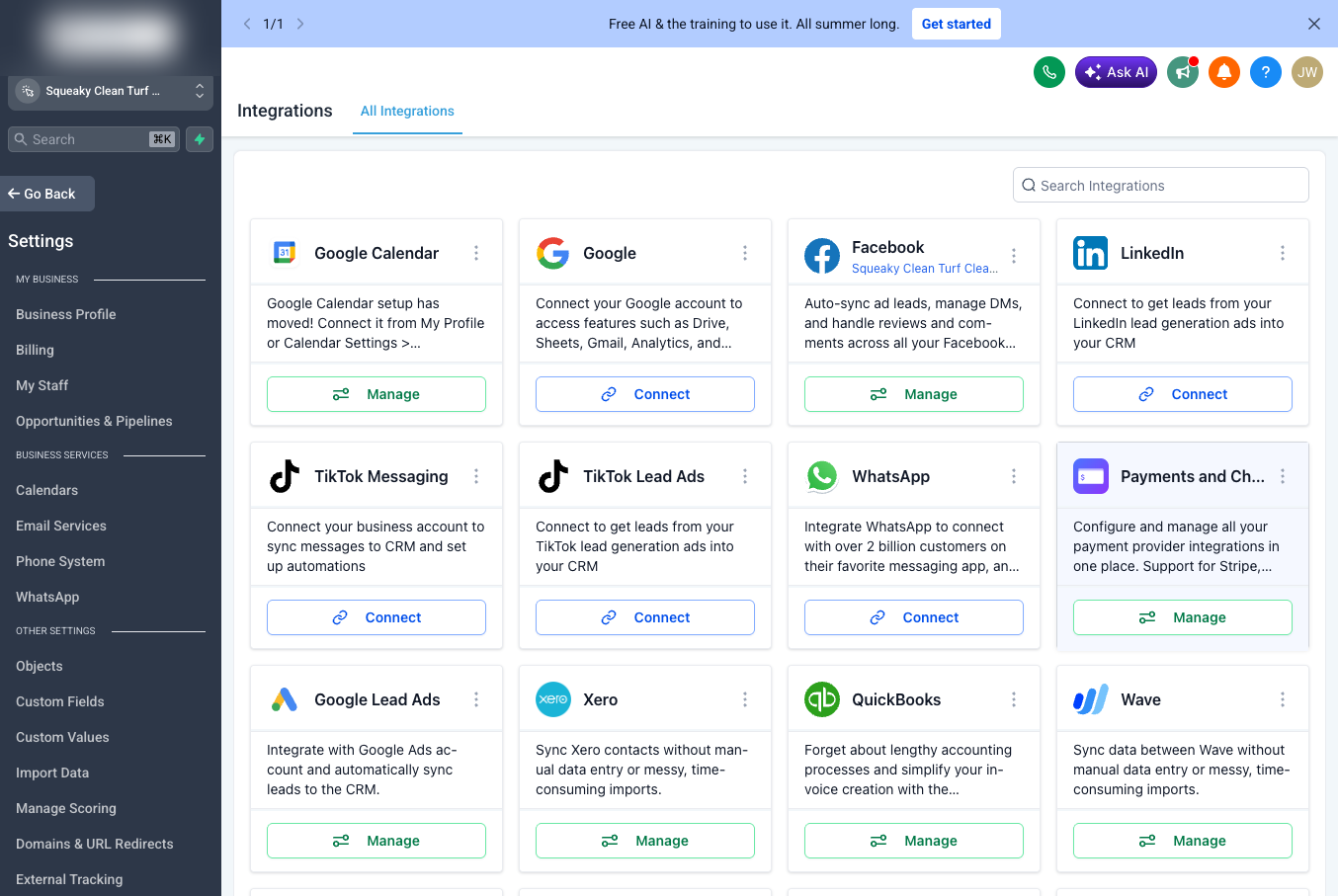
This is the part most migrations silently get wrong, so it got the most verification. Website quote form, contact form, newsletter, Shopify orders, web chat, Facebook and Instagram DMs, and Google reviews — every channel now lands in GoHighLevel with the right tags, custom fields, and downstream automation, across two sub-accounts.
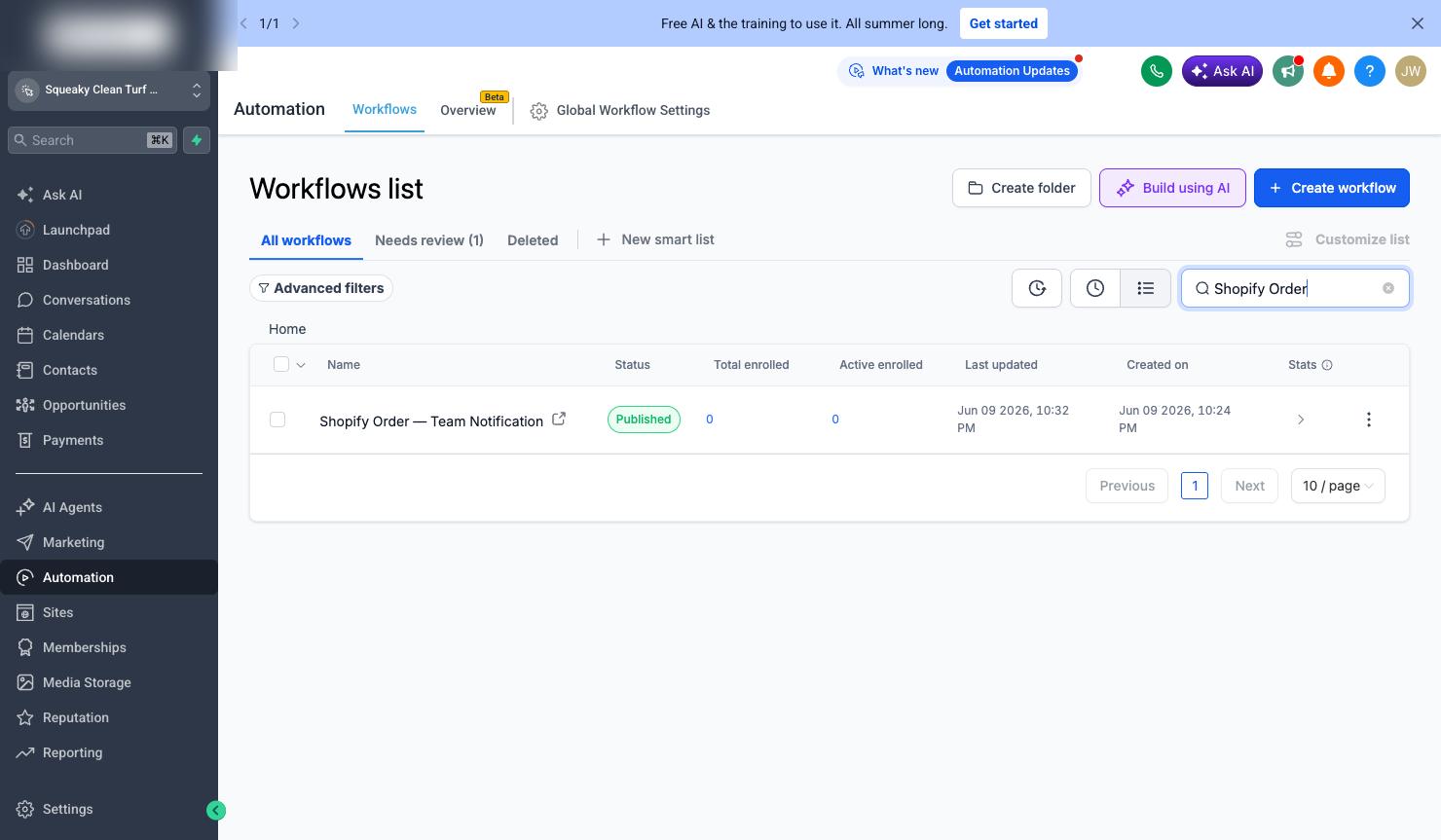
The GHL integration surface for one sub-account — the channel inventory the agent audited one by one.Built new for the products sub-account: every Shopify order now triggers a team notification workflow. Published — and then verified.
Merchant Center: from "misrepresentation" to clean listings
Fixed the mismatched online store URL — the feed still pointed at the old WooCommerce domain
Wrote a custom XML product feed as a Cloudflare Pages Function — pulling live Shopify data and emitting the identifiers, measurements, and shipping attributes Google demanded
Re-verified the domain and uninstalled the half-configured Shopify Google channel that was fighting the feed
What broke, and how it got fixed
Honest migration writeups include the failure log. Here's ours — abridged to the instructive ones.
Problem
Root cause
Fix
"Trusted on HOMES / GYMS" tiles showed swapped images
Files renamed during an image update, then cached at the CDN
Renamed files to force cache invalidation — cache-busting by filename beats waiting for TTLs
Quote notifications going to an old agency address
Legacy workflow recipients
Recipients replaced with the two owners only
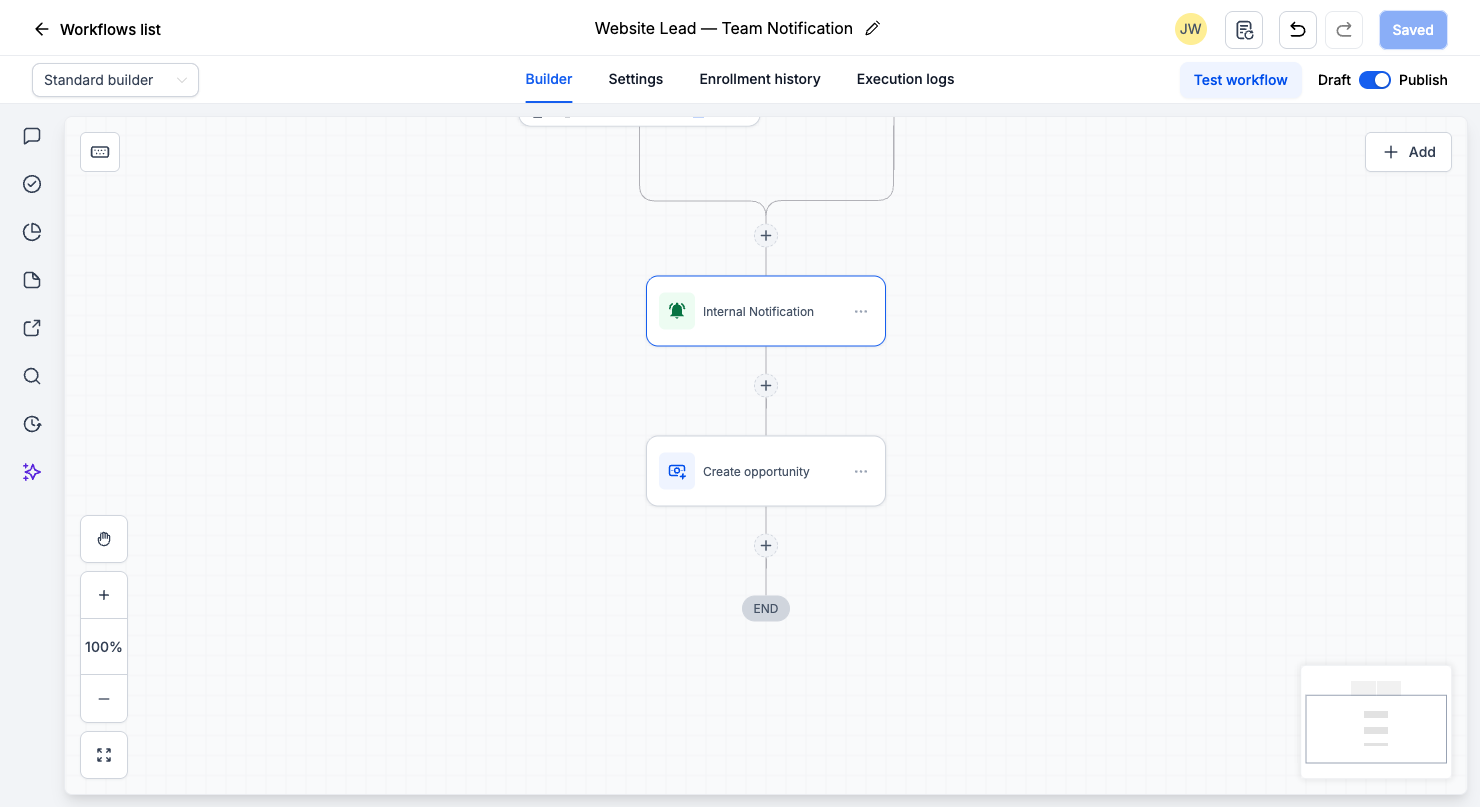
Website leads not appearing in the sales pipeline
The old GHL form created opportunities; the new site's API path didn't
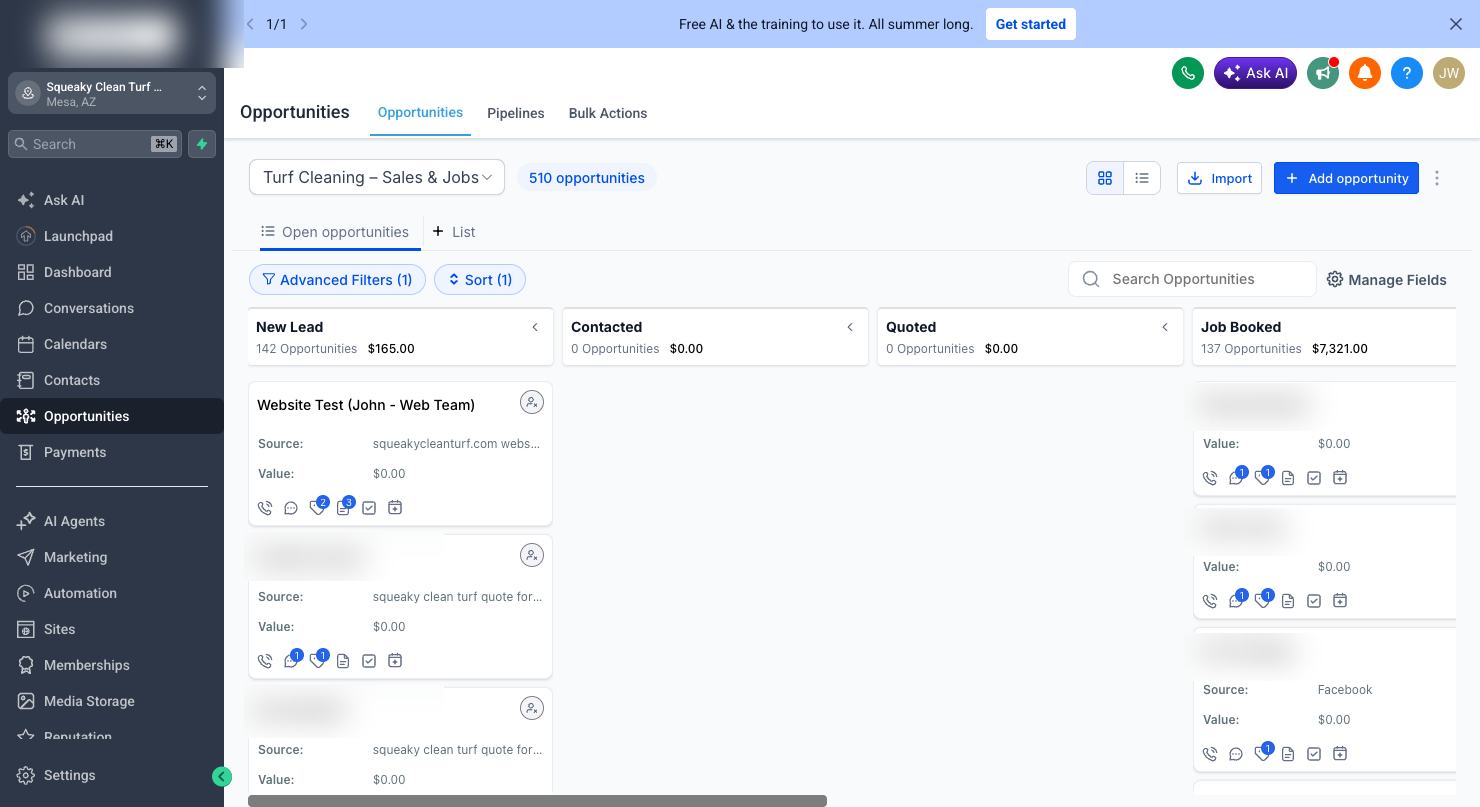
Added a Create Opportunity step — verified with a live test lead landing in "New Lead"
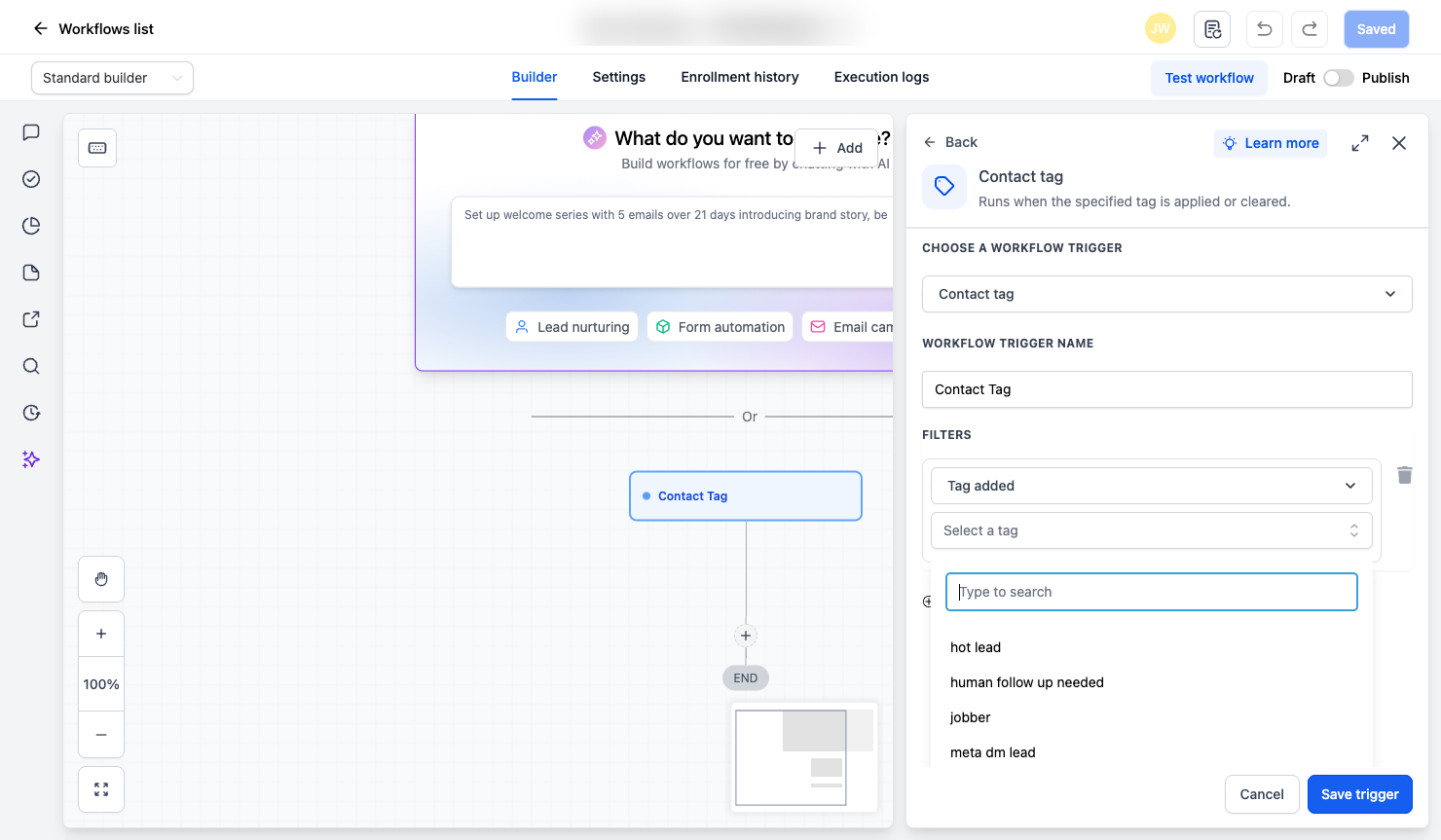
Website leads invisible to the AI sales agent
The AI workflow only triggered on the old GHL form
Added a tag-based trigger so website quote leads also reach the agent
Workflow emails couldn't show smell/sqft/package for website leads
Those lived in GHL custom fields the new site never populated
Site now upserts the same custom fields by key — merge tags work identically for both lead sources
Phone-call tagging workflow: zero executions in 30 days
No number exists in GHL's phone system — calls ring the owners' real line
Flagged as a business decision (tracking number vs. NAP consistency), not silently "fixed"
The cache bug in the wild: that's a gym in the HOMES tile. The CDN had cached the old filenames with new content.The website-lead workflow after the fix — Internal Notification, then Create Opportunity. Before this step existed, web leads never reached the pipeline.
The part worth writing home about: an AI agent with a browser bridge
Most of the stack above has APIs. The critical 20% does not. GoHighLevel's workflow builder has no public API for editing triggers, actions, or notification recipients. Merchant Center's diagnostics are a UI-only experience. Shopify's admin onboarding is click-ops.
This is where the workflow got unusual. Fable 5 ran inside Cursor with Buddy as the bridge — a persistent Chrome session the agent could drive: navigate, click, fill, screenshot, and (crucially) read — execution logs, diagnostic panels, saved-state confirmations. Fable 5's adaptive reasoning meant the agent could plan a workflow edit, execute it across a dozen UI steps, and notice when the page state didn't match its expectations — the kind of long-horizon judgment that separates an operator from a script.
Buddy by AHMEEGO — the agent that served as the live browser bridge for this migration.
That combination changed three things:
1. The no-API wall disappeared. The agent edited GHL workflow recipients, rewrote notification email bodies with merge fields, added pipeline-stage actions, and created tag-based triggers — all through the same UI a human VA would use, but with every step screenshotted and verifiable.
The agent configuring a tag-based trigger in GHL's workflow builder — an interface with no public API.
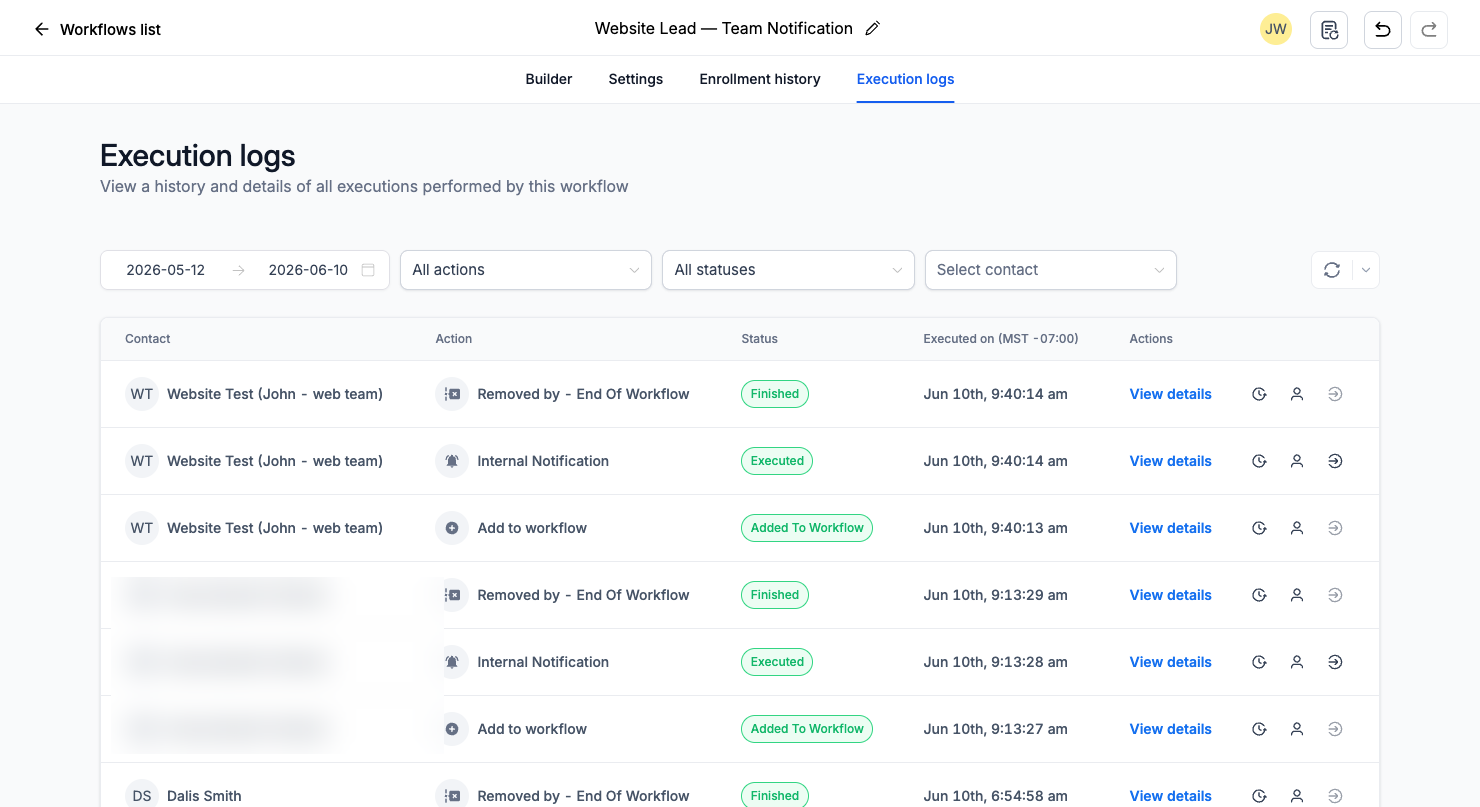
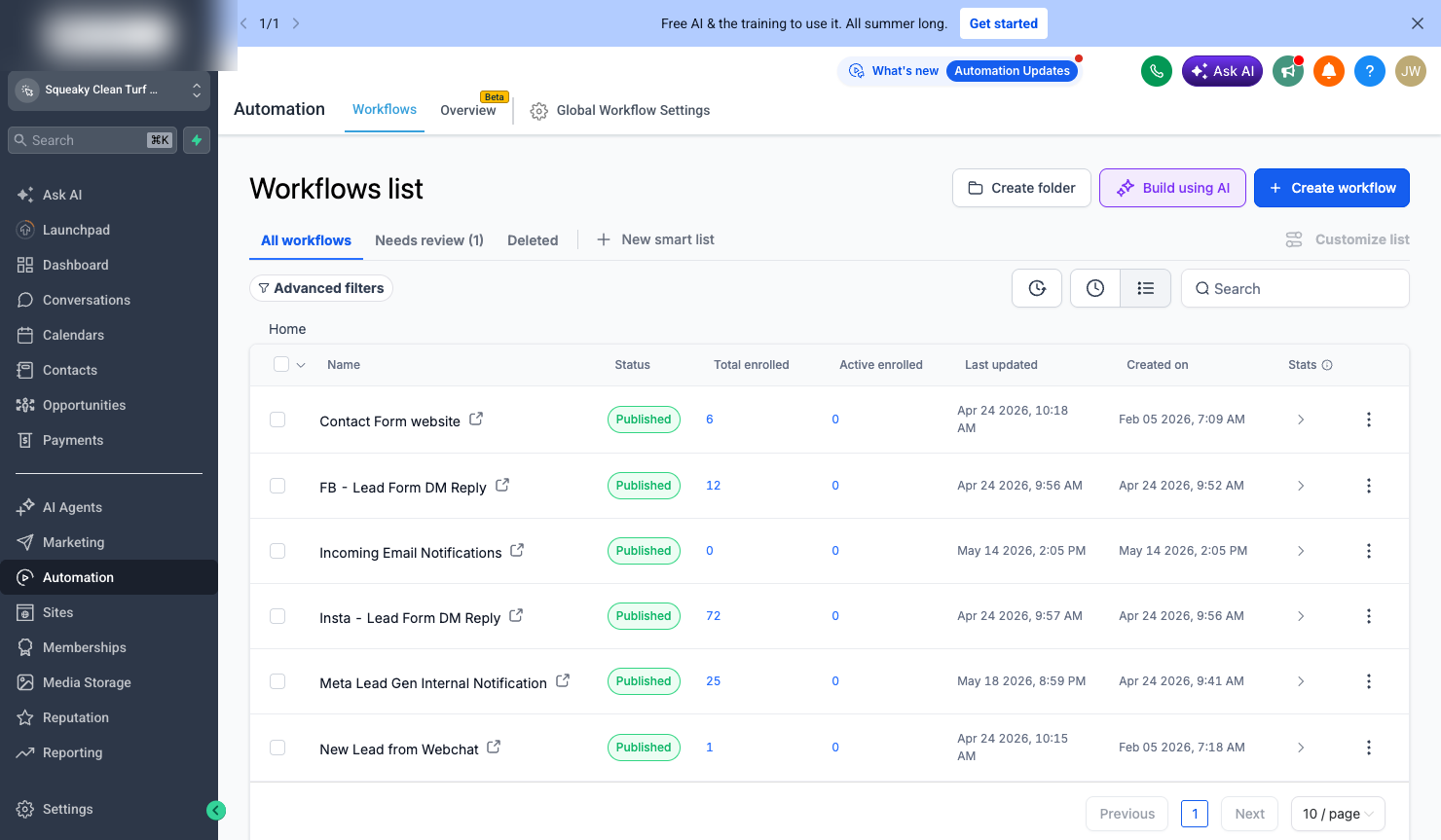
2. Verification became evidence-based, not vibes-based. "The form works" was demonstrated by: submit a live test on the production site → watch the contact appear in GHL with custom fields → watch the workflow execution log show Internal Notification ✓ and Create Opportunity ✓ → see the test lead sitting in the pipeline's New Lead column → delete the test data. Every published workflow with real enrollments — fourteen of them — was checked against its execution logs the same way.
End-to-end proof: the labeled test lead in the New Lead column. (Customer names blurred.)Execution logs as ground truth: the live test firing every step. Verification, not vibes. (Lead name blurred.)
3. The audit loop closed in hours, not weeks. Finding an old agency email address buried in a notification action, or noticing a phone workflow had never fired in 30 days, is exactly the kind of thing that survives years in a normal handover. A bridge-equipped agent walks every workflow, opens every action, and reads every log — because doing so costs minutes.
One of two sub-accounts' workflow inventories — every published workflow with real enrollments was walked and verified.
Adaptive depth. Fable 5 decides how hard to think per task. Renaming an image file gets a fast pass; reconciling two sub-accounts' automation inventories against five lead channels gets full-depth reasoning. Nobody tunes a dial.
Code and operations in one loop. The same session that wrote the Astro components and the Merchant Center feed function also drove the GHL workflow builder and read Shopify's admin. No handoff between "the developer" and "the person who configures the CRM" — which is precisely where context dies in traditional projects.
Cursor as the cockpit. Version-controlled code, terminal, and the browser bridge live in one place. Every site change was a reviewable diff; every UI change was a screenshot. The owners could see exactly what changed and why.
The economics. The glue work — the part agencies quote weeks for, the part that always ships half-verified — collapsed into hours. Not because the model typed faster, but because the verify-fix-reverify loop had no human context-switching cost.
The takeaway: the bridge is what makes an agent an operator instead of a code generator. When the agent can see what the customer sees, click what the admin clicks, and read what the auditor reads, "done" stops meaning "deployed" and starts meaning "verified."
Industry questions this project answers
"Will migrating platforms tank my SEO?"
Not if you treat URLs as contracts. Page-level 301s wherever a real equivalent exists; explicit redirects even for pages you're killing; Search Console re-verified before cutover and sitemaps resubmitted immediately after; NAP kept identical to Google Business Profile. Consolidating two related domains usually helps — it concentrates link equity instead of splitting it.
"Is a headless/static site bad for SEO?"
It's the opposite, with one caveat. Static HTML at the edge means fast LCP, no render-blocking plugin soup, and content fully present in the initial response. The caveat: schema, meta, redirects, and feeds don't come from plugins anymore. You own them in code. More work up front, far more control forever after.
"What about E-E-A-T and AI search?"
The same pass that helps Google's quality systems helps LLM-driven search: LocalBusiness schema with real founders as Person entities, Service schema with real Offer pricing, FAQPage answers that match what's visibly on the page — and removing claims that weren't true anymore. AI systems increasingly cross-reference; inconsistency is the new thin content.
"Do I lose my CRM automations when the website changes?"
This is the most under-discussed migration risk. Forms are easy to rebuild; the wiring behind them is where businesses silently lose leads. The fix pattern from this project: make the new site populate the same custom fields by key the old forms used, then add tag-based triggers alongside the legacy form triggers — both lead sources flow through identical downstream automation.
The measurable benefits
Dimension
Before
After
Hosting
GoDaddy WP hosting × 2
Cloudflare Pages (effectively $0 at this scale)
Attack surface
WordPress core + plugins × 2 sites
Static HTML + 4 small serverless functions
Checkout
WooCommerce plugin chain
Shopify (PCI handled, Shop Pay, native UPS/USPS)
Lead capture
WP forms, partially wired
Every channel verified into GHL with logged executions
Content changes
WP admin, unversioned
Git — reviewable, diffable, instantly deployed
Deploys
FTP-era
~20 seconds to global edge
Shopping ads
Misrepresentation warnings
Clean custom feed with full attributes
A reusable migration checklist
Inventory before you touch anything — every URL, form, automation, feed, and subscription
Map URLs page-by-page; write 301s for everything, including pages you're killing
Migrate commerce data first (customers → orders → products) and reconcile counts
Never silently migrate active billing — surface subscriptions for a human decision
Rebuild forms to populate the same CRM fields by key — not just the same visible inputs
Add new triggers alongside legacy ones; don't rip and replace
Own your schema in code: LocalBusiness, Person/founders, Service+Offer, FAQPage
Custom product feed if Merchant Center complains — a 100-line serverless function beats fighting a plugin
Cache-bust by renaming files, not by waiting
Live-test the full chain in production with labeled test data, verify against execution logs, then clean up
Walk every automation's execution history — zero executions in 30 days is a finding, not a footnote
Write down what you intentionally didn't change so future-you doesn't "fix" it
Want eyes like this on your stack?
Buddy — the same agent that bridged this migration — audits Google Ads accounts live, verifies conversion tracking in a real browser, researches your market, and hands you a prioritized fix list with real numbers. Free credits to start; bring your own API key if you prefer.
The interesting part of this migration isn't Astro, or Shopify, or even the SEO mechanics — those are all well-documented individually. The interesting part is that the glue work — the part agencies quote weeks for, the part that always ships half-verified — was done by an AI agent that could write the code and drive the browser and read the logs that prove the system works.
When the agent can see what the customer sees, click what the admin clicks, and read what the auditor reads, "done" stops meaning "deployed" and starts meaning "verified."
— John
Sources & references: Direct observation from executing this migration between May and June 2026 for Squeaky Clean Turf (squeakycleanturf.com), with the owners' permission to publish. Screenshots are from the live production site and the GoHighLevel, Shopify, and Merchant Center admin surfaces used during the work; customer names, third-party branding, and internal identifiers have been blurred. Tooling: Claude Fable 5 by Anthropic running in Cursor, with Buddy (ahmeego.com) as the live browser bridge.